
Ganesan, A. V., Varadarajan, V., Kjell, O., Ringwald, W., Feltman, S. M., Luft, B., ... & Schwartz, H. A. (2026). Proceedings of the 64th Annual Meeting of the ACL (Vol. 1), 47160–47179.
HLAB NEWS
5 papers at ACL 2026
San Diego, CA · July 2–7, 2026
Overview
HLAB at ACL 2026
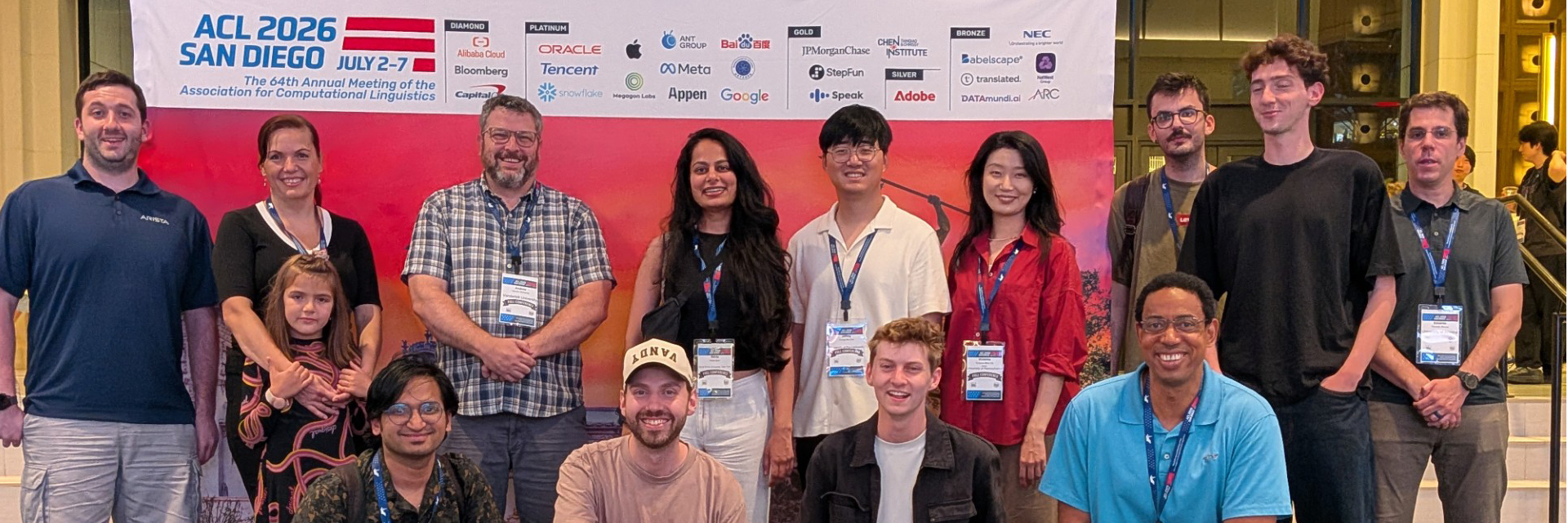
The Human Language Analysis Beings traveled to San Diego to attend the 64th Annual Meeting of the Association for Computational Linguistics (ACL 2026).
HLAB contributed five papers to both the main conference and CLPsych workshop.
The work spanned topics in longitudinal NLP, human language modeling, and language based mental health assessments.
Adithya V. Ganesan, PhD student at HLAB, shares his reflections on the conference and the ACL community below.
"Evaluating Document-Tuned Transformer Representations for Person-level Mental Health Assessment"
at CLPsych Workshop.
RESEARCH
What We Presented
Soni, N., Kunjadiya, D. V., Shah, P. P., Mohanty, D., Schwartz, H. A., & Balasubramanian, N. (2026). Proceedings of the 30th Conference on Computational Natural Language Learning, 121–144.
Soni, N., Schwartz, H. A., Boyd, R., Bui, P. L., Mahwish, S., Nilsson, A. H., ... & Mohammad, S. (2026). Proceedings of the 20th International Workshop on Semantic Evaluation, 3731–3752.
Feltman, S., Ganesan, A. V., Ringwald, W., Schwartz, H. A., Kotov, R., Luft, B., ... & Kjell, O. (2026). Proceedings of the 10th Workshop on CLPsych, 43–55.
Marker, A., Kjell, O., Varadarajan, V., & Schwartz, H. A. (2026). Proceedings of the 10th Workshop on CLPsych, 178–187.
RECAP
Team Reflections on ACL 2026
TEAM REFLECTIONS — Adithya V. Ganesan, PhD Student, HLAB
“
San Diego was a fantastic place for the conference. With ACL coinciding with the July 4th weekend, the lab watched fantastic fireworks from the pier, caught the sunset from a beautiful beach, and witnessed the Mexico and England knockout game in a highly electric location surrounded by passionate Mexican fans, with delicious tacos throughout.
I was happy to put a face on the papers I read, meeting and getting to know the people behind them, and catching up with community members I have connected with through previous ACLs.
Three threads from the week have stayed with me: (i) what a language sample should produce for mental health care, (ii) what the ACL community takes as its object of study, and (iii) whether the reviewing system can absorb another cycle of growth.
What Mental Health Research Needs from NLP
Philip Resnik's invited talk asked what mental health research needs from NLP+CSS and what the exchange offers in return. His accounting was that the past decade has improved how well we estimate mental health and risk from language, while where any of it lands implementationally within the care system remains unresolved. The analogy he offered has stuck with me: a blood or urine sample feeds a medical profile in traditional care, and we should be working toward a language sample that generates a patient report in mental health care. He pressed the audience on the difference between tasks and problems, on construct validity, and on doing this work with psychologists rather than adjacent to them. Colin Walsh's CLPsych keynote took up the same thread from the deployment end, showing real effects from machine learning technologies running inside a working healthcare system under his pragmatic trial designs. It was a fantastic and encouraging talk for those of us who intend to keep doing this work. The question he left with the computational side of the room was how a technology gets instrumented, which means opening a dialogue with people who understand how data flows through the health system and how information has to be presented in a decision support tool. His second question was simple and often overlooked, on how to find solutions in a way that does not make already busy people in healthcare busier, since implementation has to make an appropriate change to the system already in place. The CLPsych panel of Colin Walsh, Justin Tauscher, and Anat Brunstein Klomek, moderated by Resnik, kept returning to the availability of high quality data as the condition for this research reaching high impact. Tauscher described IMPACT-MH, an NIMH consortium collecting individually measured behavioral phenotypes across thirteen institutions, with privacy protections built into the collection design and an explicit aim of sharing the resulting data for research.
What the ACL Community Studies
Resnik's conference keynote on the relationship between computational linguistics and AI was one of the two topics that filled the networking breaks and social events. He implored the community to think about what ACL research is about, given how much of the proceedings now treats language merely as an input-output modality rather than as the object of interest. The community set out to understand language computationally, including the human behind it, how language serves as a window into affect, cognition, and behavior, and how language shapes communities and is shaped by them in turn. His fear is that the current trend diminishes the ACL venues into a tier-two NeurIPS or ICML, if it has not already.
The Reviewing Crisis
The other topic was the reviewing crisis, which filled the best attended business meeting I have been to in six years of ACL. ACL ARR received record submissions this cycle, and the exec committee's position is that the rising trend is not manageable even at one more repetition, since there are not enough reviewers qualified by the current definition of at least three ACL or ACL-level papers. The first proposal is to expand desk rejection beyond formatting and resubmission disclosure to subject area fit and paper quality, with ACs judging problem impact and filtering AI slop before reviewers are assigned, which raised the objection that journals are running into the same shortage while already working this way. The second is to prioritize assignment for papers with at least one qualified author available to review and send the rest to a lottery, which raised concerns about the barrier to entry for new members of the community.
”